
You figure out what you actually want.
The assistant asks the questions that surface your own meaning, then steps back.
How it works
Everything Etcera does turns on a loop: where you are, what you choose, what happens, what it means to you, and where that leaves you next. Around that loop the assistant can do a great deal. It listens, reasons, drafts, plans and remembers. Two steps stay with you: choosing, and deciding what an experience means.
The assistant participates. You author.
Real work
Bring the work in front of you. Think a problem through in conversation, lay out the paths you could take and compare them, draft a plan with the milestones and tasks it needs, keep them on a board and a calendar, and find what you wrote months ago.
You do not have to name an intention before you get help. When one is forming, Etcera keeps the work connected to it.
What this changes
The assistant asks the questions that surface your own meaning, then steps back.
Suggestions stay provisional. Changing your mind is treated as authorship, never failure.
Earlier wordings are kept. When something old becomes relevant again, Etcera surfaces it.
How the loop runs
A thought finds its shape in conversation. You recognize what it is for, commit when you are ready, act, and look back on what changed. Each pass around the loop leaves you somewhere new, and the next one starts from there.
Capture
No format. No template. Write what is in your head, raw and half-formed. Nothing has to be organized before it is worth keeping.
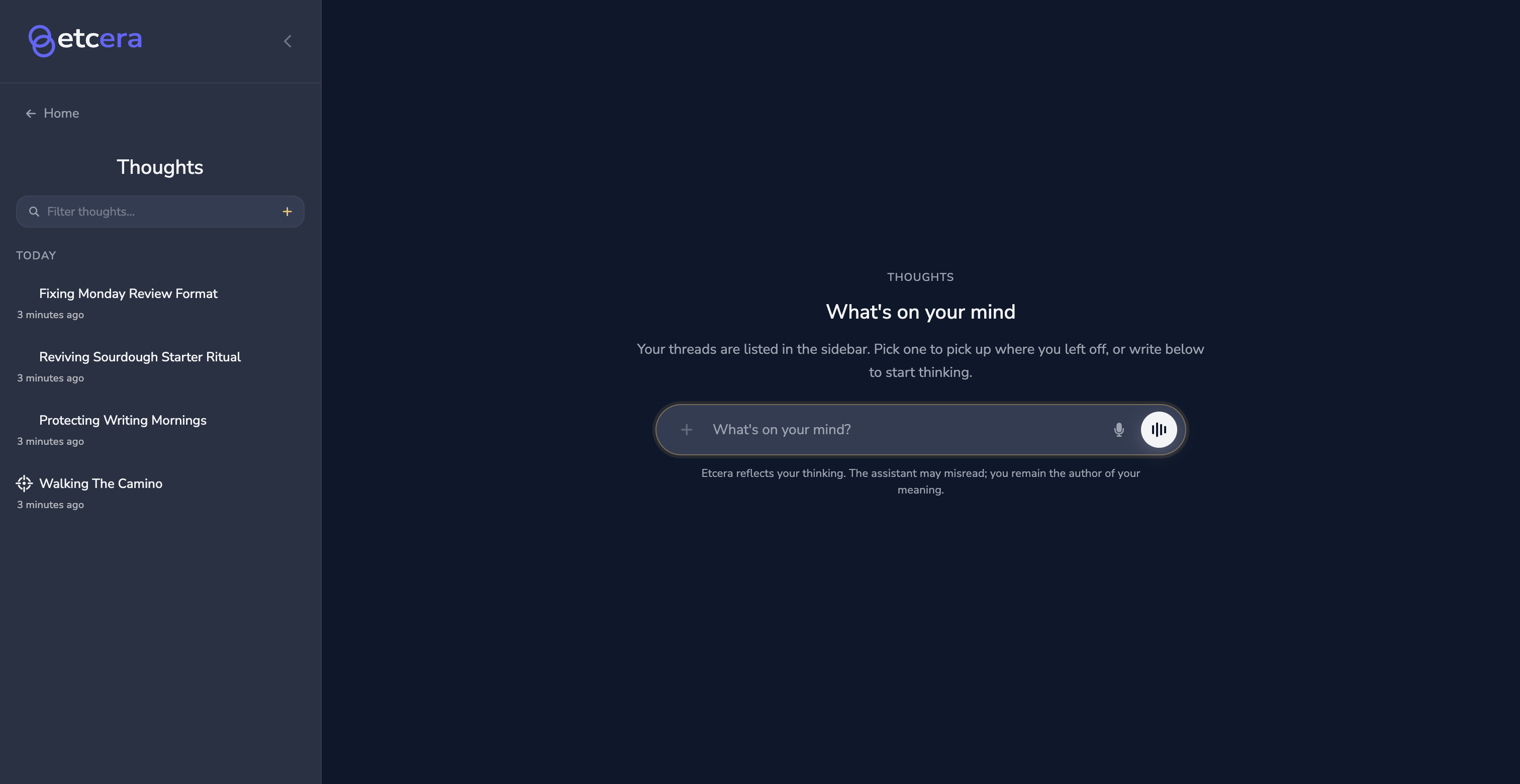
Clarify
The assistant asks questions that help you find your own meaning, rather than steering you toward an answer. The output is wording you would recognize as yours.
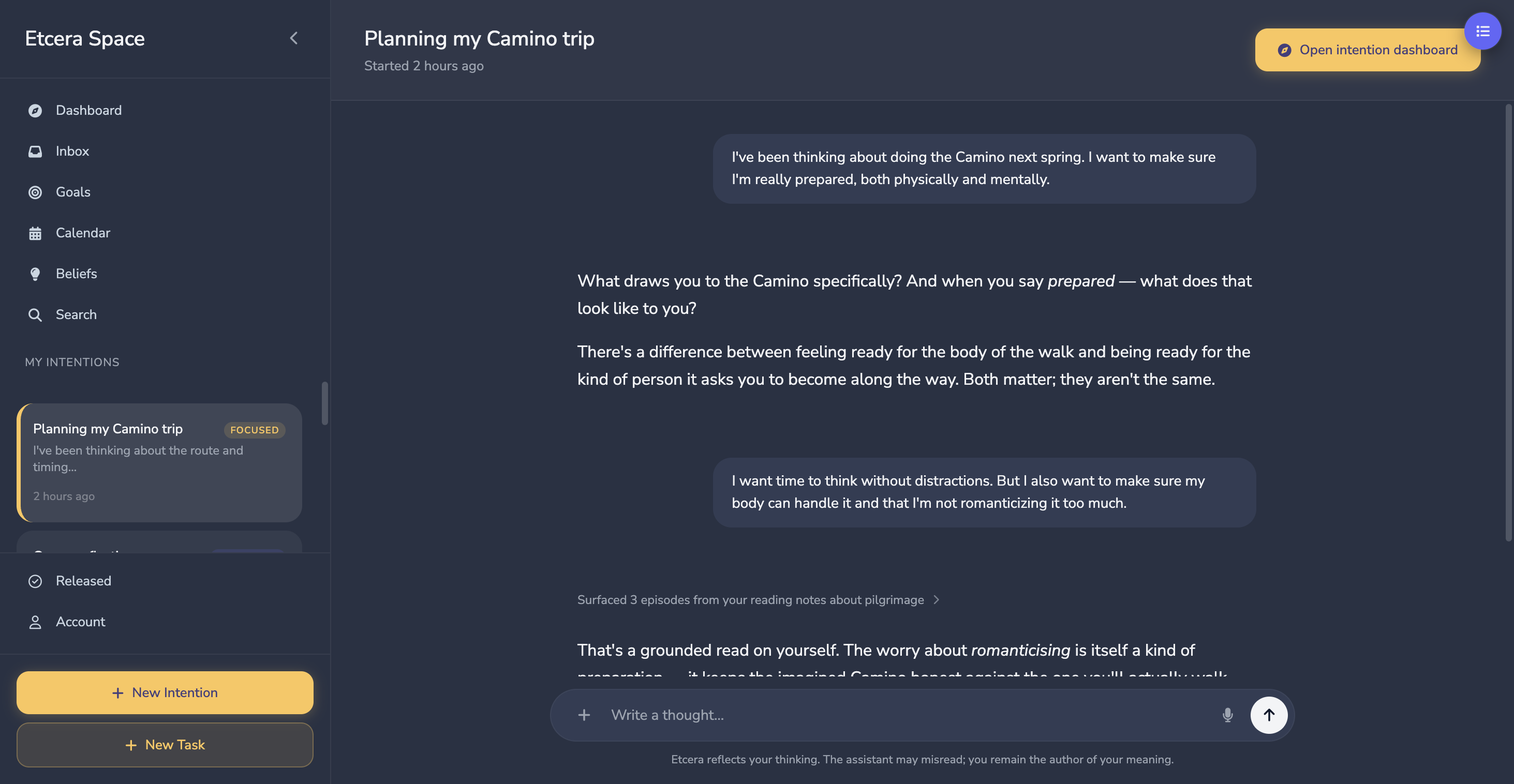
Recognize
You decide that something meaningful is present, and you name it. Etcera may notice an intention emerging, but it never decides on your behalf that one exists.
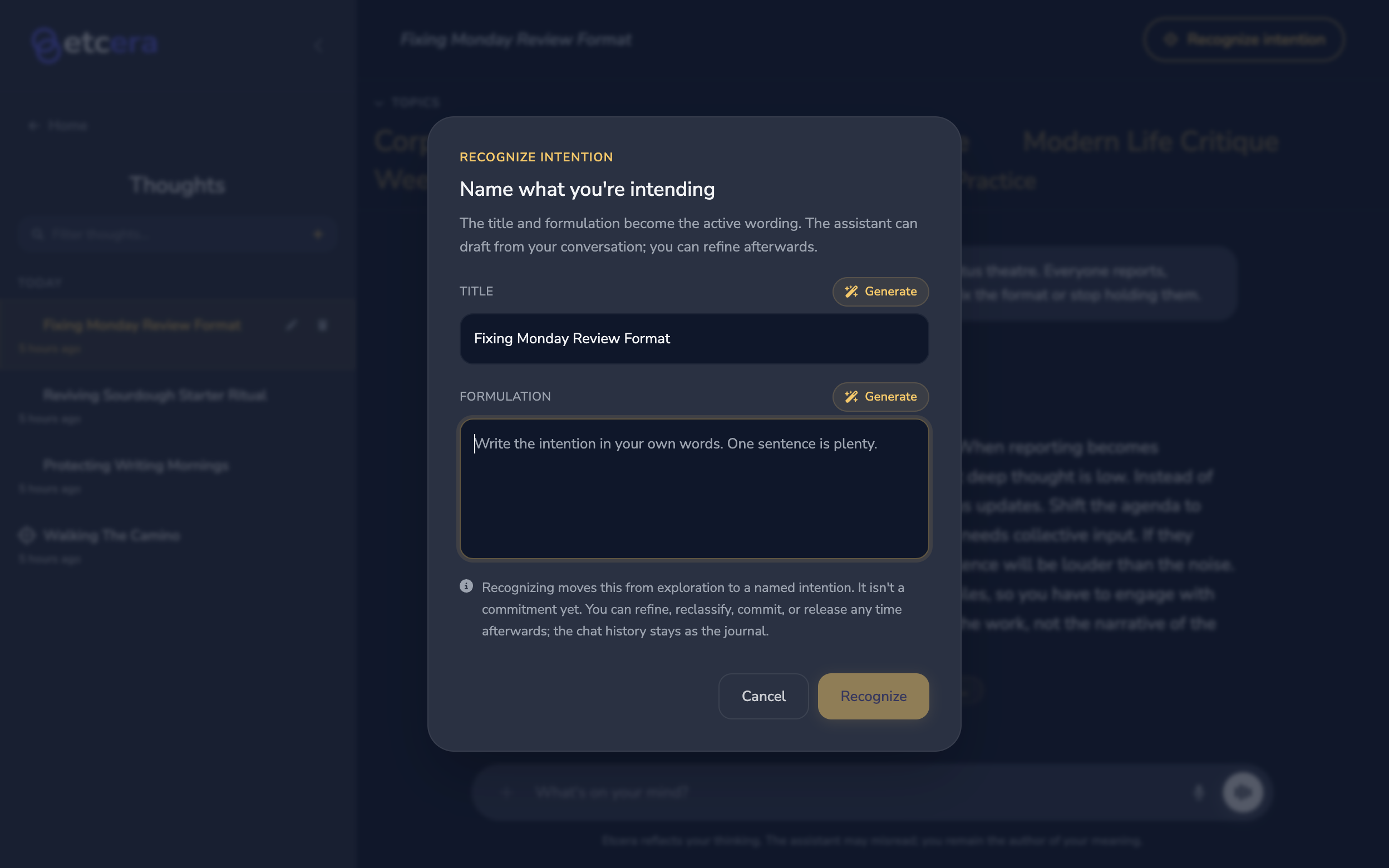
Commit
Commitment is taking responsibility for carrying an intention forward, not a feature to unlock. It belongs to the intention itself, so you can change how you pursue it without breaking it.
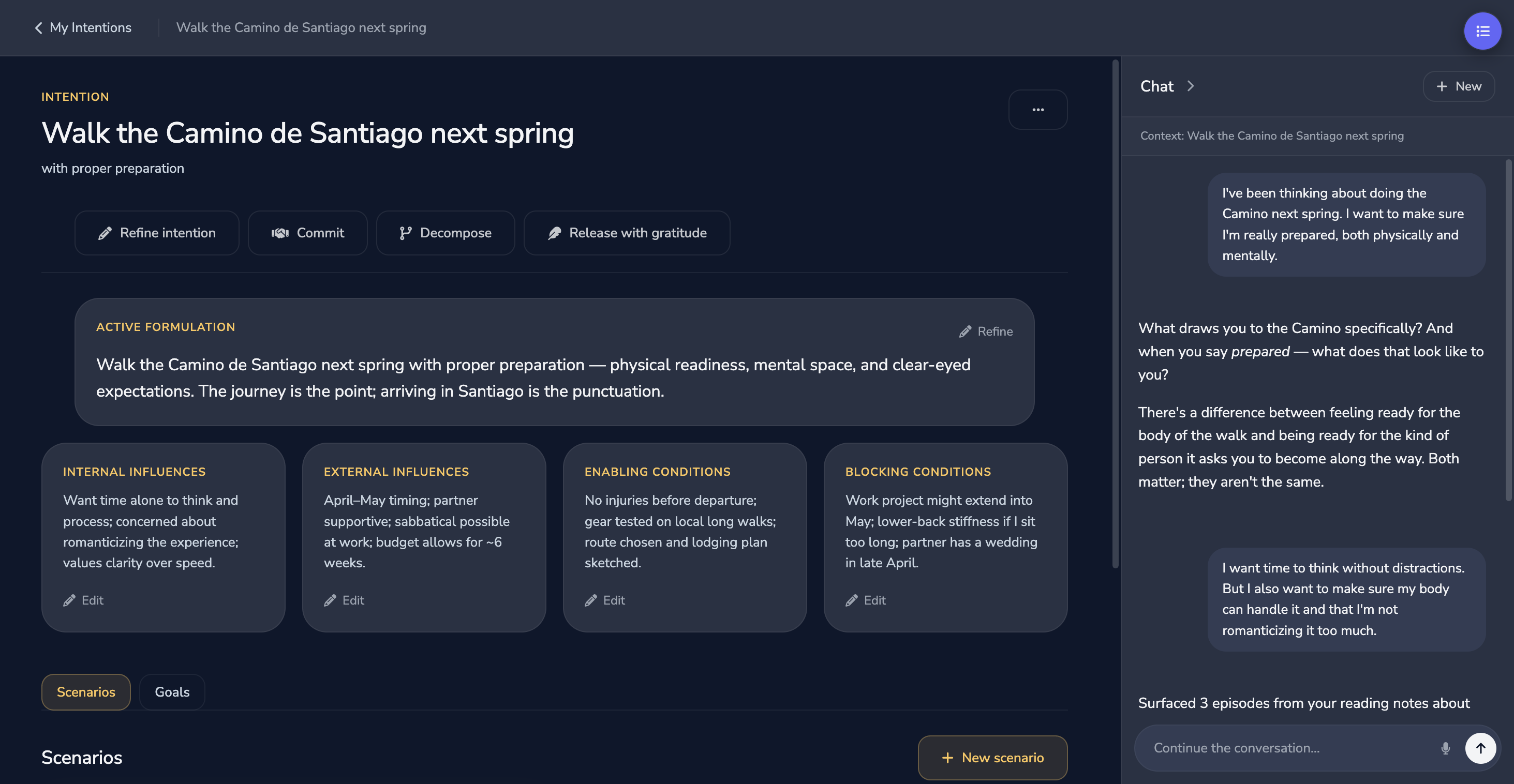
Reflect
After action, the system records what changed. Earlier wordings are kept; the lineage of your becoming stays traversable. Releasing an intention ends its claim on your future without erasing its place in your story.
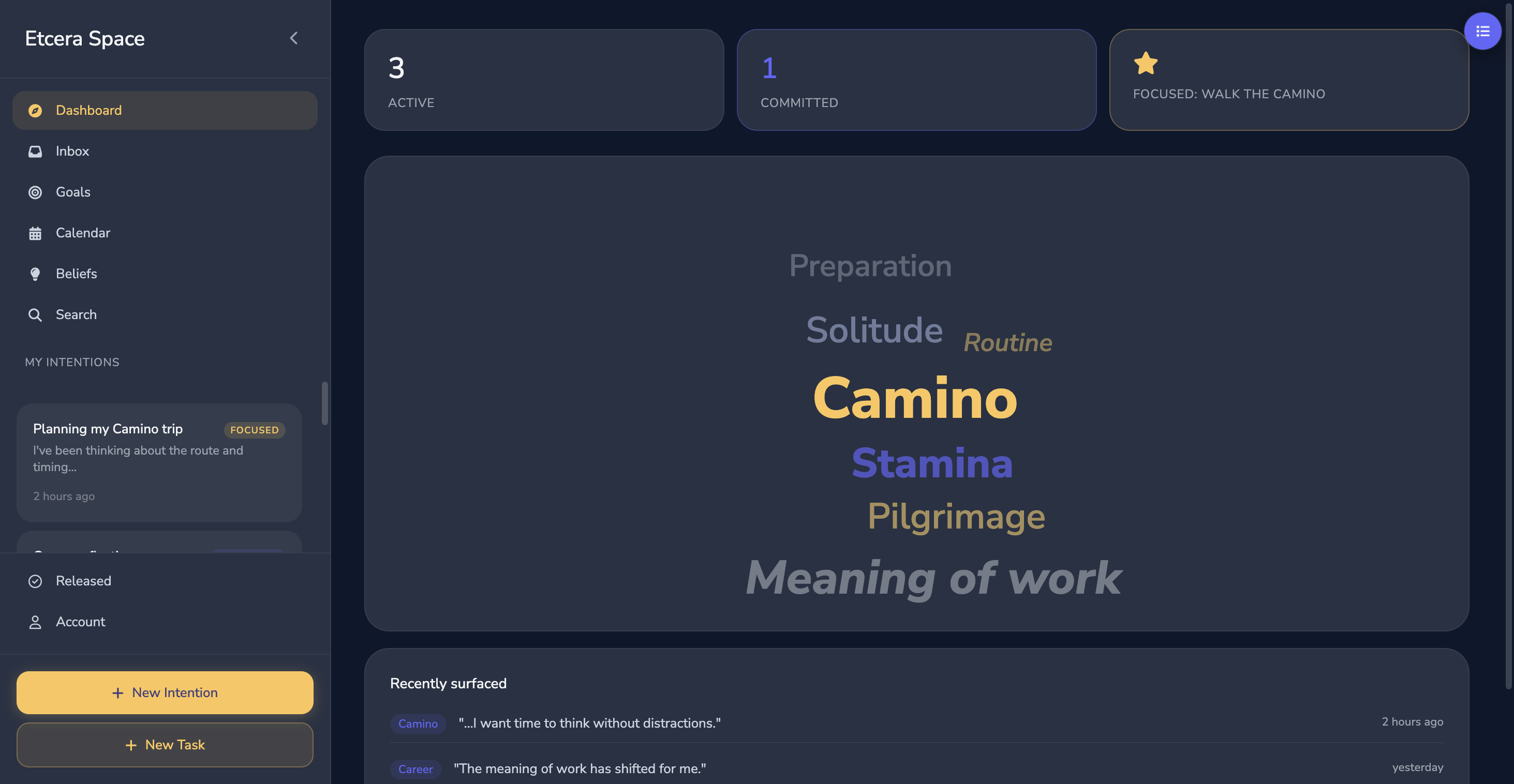
Standard AI flattens you. It overwrites the past with the present and treats the latest version of your behaviour as the whole you.
Etcera keeps a story as a continuing thread rather than a final summary, so one story can hold that in 2024 you believed X and in 2026 you believe Y. Both are kept. Both are relevant. When a past intention becomes meaningful again, it surfaces without being prompted, and without overwriting where you are now.
What you see at any moment is your state: which stories are active, which intentions are guiding you, what feels possible right now. It is reconstructed from what you have shared and authored, never stored as a fixed version of you. It reflects where you are. It does not decide what you do next.
That story is yours, and it is the personal layer of something larger. Etcera Gather, still to come, will be AI in service of what you choose to become with others: your authored self brought into what a group chooses, on your terms. Space is what is on offer today.
Intention Is All It Takes
Read the paper for the longer argument. Today's models often attend to patterns in data, with no intrinsic connection to what a person cares about. Binding a language model and a reasoning module to human intention is what closes that gap.
The loop above is what the paper calls Think, Do, Reflect. It makes the case for that loop, and for why one move answers two problems at once: AI alignment, and human agency. Read it in full, or see what Etcera is for.